The Ultimate Bryan Hitch
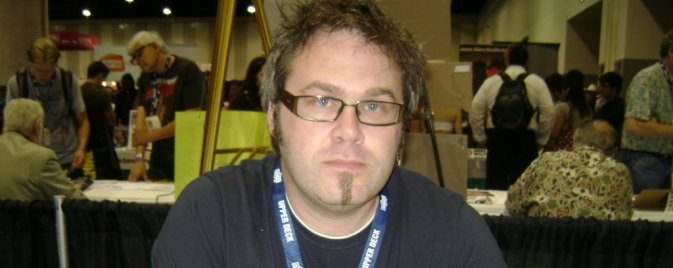
Interview by Alex Hamby - HeroRealm.com - November 21, 2005
Bryan Hitch stopped by Wizard World Texas a couple of weeks ago, and Hero Realm was there to talk to him about his latest project, THE ULTIMATES ANIMATED FILM.
HeroRealm: Hi, I’m Alex. I’m with Hero Realm. I don’t know if you’ve ever heard of the site.
Bryan Hitch: Yeah, oh yeah, I follow it. I like your reviews.
HR: Well, thank you. I remember back in the old days when Mark Millar had on his website these quotes about THE ULTIMATES and how he’d be getting the title out on time and be “the darling of Hero Realm”.
BH: Yeah, it’s a good site, and I actually follow it. Mark and I try to follow the Internet fairly closely. I do lurk a lot.
HR: What do you get out of that?
BH: Sometimes it’s just to know you’re hitting your mark. Even though much of the creative process is done solely for ourselves. You know that you have an audience too. While you might not want to completely tailor what you do to that audience… you put something like this traitor storyline, you want to know that you are pulling this off. You’re hitting the mark. People are guessing. They’re trying to read between the lines that you’re setting up.
You don’t get message pages any longer. Feedback is electronic, and so there are times when I’ve read a review online, and it’s been gratifying to know that reviewers are noticing some of the tricks I’ve pulled to do a bit of storytelling. It’s been appreciated on another level. You don’t get that unless you monitor what the reaction is. Companies do this all the time in movies and television. You’re kind of self-contained when you do a comic. We want to know creatively that we’re hitting the right points.
HR: And you feel like you’ve received the correct responses from people?
BH: Actually, yeah. I think especially the traitor storyline, which happens to be a very slow burn from the very first issue of Ultimates 2. We knew who it was going to be from Ultimates 1, so we were playing a very long game. If we decided not to do Ultimates 2, it’s not as if any of the material would have been wasted because we just knew we were going to do this next time. So yeah, I guess I think we have hit those marks. Nobody knows who it is. Nobody’s guessed.
HR: I’ve got no idea who it is.
Congratulations on the DVD.
BH: Thank you.
HR: How did you get involved?
BH: Well, when they began to go into early production, they got in touch. I have to stress to you that the material that we did on The Ultimates is wholly owned by Marvel. They purchased the rights in perpetuity. They can do what they want with it. They can make a live-action movie that’s a literal word-for-word adaptation of our work and not have to pay us any money or involve us at all in the project. That’s legally fine. However, Craig [Kyle] was determined that once they knew, without question, that they were going to do this as their first project, they were going to do this line of features. They were equally determined that they would consult with us about it. They didn’t have to do that, and they didn’t have to pay us the money they’re paying us. They did this because they like the book.
They noticed that it’s quite widely followed in multimedia circles and computer games. I most recently did designs for the Hulk game for Universal, and that came out of them reading the comic and wanting the same sort of thing again. They wanted to get me on board to just give me a list of characters they are going to use. Let me go to town on them, then take them away to their development team and work on them. Again, much as happened with the DVD here. So Craig basically just got in touch and said that we’re going to be doing this; we’d like you to consult with us and Lions Gate. We’d like you to read the script and offer any comments. It came to them asking me to design some new characters for the second one because we hadn’t used them in our book, and they wanted to get my Ultimate take on them, as it were. They then took them to the development team again. I did a whole series of background illustrations for some characters just to show some different directions. And of course they had me do all the display art. All the public artwork because they were determined to keep it within the area creatively that it had come from. I was delighted because they could have easily gone to any ole’ body. They could have just had the standard DVD cover. They could have used a still from the movie. They could have used any standard approach that you see with a game or a movie.
HR: How work-intensive was it?
BH: What my work on the DVD?
HR: Yeah.
BH: Very little. They’ve been asking me to do these pieces. I’ve been slowly trickling them for four or five months. I just finished a Hulk game by doing the box cover art for that. And then these ones came up, and it’s a nice, steady trickle of stuff from outside comics that relates directly to the work. It’s not intensive at all. In fact, it’s been an absolute pleasure. Today’s the first time I’ve seen that footage. It’s just recently been available, and they didn’t want to ship it over. Before, it’s just been still and test pieces and some line art and all the design stuff. Which I’ve gotten to look at the whole process.
HR: How does that feel seeing your rendition of these characters translated to film?
BH: It’s great! It’s a very good feeling. They could have done something radically different. It’s very much its own animal. You can do this slavish adaptation page for page, but there are some things you can see on the DVD that you can put in panel-by-panel comparison with some of the frames in the film. That’s been deliberate on their part. I think it’s fantastic. I’m really excited by it. It’s also just from the point of view that we’ve hit the mark with what we set out to do. Only a handful of issues, really, have hit the public consciousness level and the media consciousness level too. It’s a well-regarded book, which is fantastic.
HR: With regard to the book, how do you feel it has affected the industry overall?
BH: Well, I don’t know that it has. I’m probably not one of the people that chart trends, artistic or otherwise. I think it’s of its time. Comic books aren’t timeless. They’re very much of the zeitgeist of the moment. They’re the ones that sell. Dark Knight couldn’t have worked as well if it hadn’t of been in the Regan era. V for Vendetta wouldn’t have been as well done as it was if it hadn’t been developed out of Thatcherite Britain in the 1980’s.
The thing about art and life is they do tend to influence each other. I think that the truth…I think that’s what makes things factual sometimes is they strike a note that is similar to everybody, and if the material is something that smacks of now, of today, of a certain resonance, a spirit of the times. I don’t think the book is starting a trend or affecting the industry. It’s that we’re at a new face on that zeitgeist.
HR: Did you have the feeling that you were going to create something that was going to speak to the times the way that Dark Knight did?
BH: Not so we could actually say that out loud. There’s a feeling that you get sometimes that you’re just going through the motions, drawing by numbers, or just working on a piece of work that’s fairly much a process. I felt like that doing JLA. Most of my career I’ve felt that way with two exceptions: The Authority and The Ultimates. I think The Authority is the beginning of the process, and The Ultimates is right bang in the middle of the process. The Authority was part one, the start. I think Grant [Morrison] was probably right there with the Justice League and his take on that. The Authority was certainly our response to the Justice League of the time.
Mark [Millar] and I both have reached a point where we stopped looking at comics. We really get a lot of stuff sent, and we really don’t look at a lot of stuff. We’ve got our collections, and we’ve got plenty of old comics. We’re not interested in going back. We’ve got the old comics sitting there. We don’t want to create old comics either.
What interests us and what we talk about all the time is what’s happening now in the world with movies, with media, with entertainment. Interesting, fascinating is the cult of celebrity that’s built up. The way anybody can join a reality show and become a celebrity overnight and be known by millions of people cause they’ve been introduced by millions of people on that show. Furthermore, they’re no more celebrity than you are, but they’ve been noticed by more people, and however long that lasts. That’s a perennial thing. You see it decade upon decade in one form or another.
The book undoubtedly became what it was in the wake of September 11th, beyond the sense of destruction and loss. I was working on an Authority story that was knee-deep in enjoying the glory of mass destruction in The Authority, and I saw what happened and immediately stopped drawing it cause I knew it would never be published. It wasn’t going to work anyway. That’s when the media was full of military. The world was militarized again. America is a militarized nation right now; so is Britain. America is in Iraq and Afghanistan, and of course the British troops are right there too. That’s something that’s part of our public consciousness right now, and I think that shapes it. I don’t think we set out to do that. We just responded to what’s happening, and it’s easy to do when you’re open to it. Suddenly Captain America is a soldier, not a superhero. That shifts the whole tone of the book.
These two volumes are essentially one long origin story. Traditionally, you just get the six-page introduction of them fighting crime. You know, the reason they’re together. We wanted to ignore that. Essentially it’s a twenty-six-issue origin story. That’s how we’ve set it up, and now Jeph and Joe get to play with it. We could have taken the easy route and stayed forever. We love it that much. We’re not short of ideas or direction. That’s the easy thing. You’ve got to know when to leave the party sometimes.
HR: What was that decision process?
BH: I nearly didn’t do the second volume. I thought, no, I’m done. This book’s finished. I’m tired. I wanted to do something else, then Mark talked about what he wanted to do with the second volume, and things started clicking again. Then you think, “I’ve gotta draw that.”
The third volume of Ultimates came very, very close to being us. Then we had one of those times where you set down for a drink, and you came up with this other thing. And suddenly it’s going to be far more interesting than The Ultimates was to us. It’s going to be bigger, and it’s going to be the next thing. That’s the key. Always the next thing.
HR: So the next project involves you and Mark.
BH: Yeah, there is a project ahead for us. We are going to work on a project together. May not be my next project, and it’s certainly not going to be Mark’s next one. Mark’s got a six-month sabbatical. He wants to get his Millar World project up and running. We talked about a creator-owned book together. I’ve talked to other writers about some projects. There is a project I’m going to be working on for the better part of a year before it sees print. It has nothing to do with my being slow. It is the actual immensity of the project.
HR: We can see the level of detail and the level of quality in your work. What does it take for you to put out a page?
BH: To be honest, mostly a day. I know that seems odd considering the speed at which I’ve worked on them. What happens is issues are very, very intensive. The work is very intensive. I also have to feed a family. I try to keep a very regular sort of working schedule. But it ends up getting later nights and later nights; the difference between this and, say, Authority, where I did a total of 16 issues in that one year, I did three weeks per issue start to finish, relentlessly. Then a few fill-in stories, a bunch of colors, and a few extra stuff; I reminded myself of these things by looking at my old account books and realizing when the invoices went in for the number of pages. You can see it. It’s right there in black and white.
Ultimates is more intense. It is harder work. It would be easy to just stand still and just coast. I’m interested in how good things can be. How much can I lift my drawing to match the vision in my head? The issues tend to get rather intense. There is a slow start as I figure out how to play a scene. You know, you mull it around. I get up to speed, and I drew issue nine actually in four weeks. Then we had a week off on holiday; I’m here [Wizard World Texas] now, a slow start on issue ten; there’s been some other odd things to do, and suddenly three weeks have gone by, and I haven’t started the issue.
When you’re on a monthly schedule, you have to do one every four weeks. I could do that on Authority by the simple fact that I never stopped drawing the issue. The issues never finished before I got finished with issue one; I already had the script for issue four. We were so far ahead I started on issue two. What happened with those twelve issues is that it was actually just 240-odd pages in one story. I just kept going all the way through. The issue never ever ended. One day I could be drawing two pages of issue three, then draw a few pages of issue nine.
It was a completely different process. This is like peaks and troughs. It’s a slow start, a big push, the issue comes out, exhaustion, family stuff, gotta put the backdoor back on its hinges, build a fence. You know, play with the kids, remind my child who I am. Each issue seems more intense.
I was taking with Josh Whedon at the London premiere of SERENITY and we were talking about the work process. He was describing the whole process of making the movie and how much it took out of him. It was exactly how I feel about every single issue. The process of figuring out what it’s going to look like, getting the actors together, filming the thing, finishing it. Then I’m overseeing the inking and the coloring, and the book goes to press. You think, “Thank God.” But then you have to do it all over again straight away. You have to already be halfway through the issue by the time the first one goes to print. That’s not been the case here. The issue gets done, and then you have to do it again. There is a process of exhaustion and a process of start and finish. I do drawings quickly. The process isn’t. I don’t know why that is on this project. It’s beside me at every step of the way.
HR: It’s not a standard job.
BH: It’s not. It’s an odd job. I think actually I blame Mark. I don’t mean to make a joke, but Mark was recently working with John Romita Jr. on Wolverine. Romita Jr. has relentlessly worked on two books a month for most of his career. He had to drop to one a month for the first six issues of Wolverine. He couldn’t handle what Mark was asking. Mark doesn’t compromise what he’s asking for. I always give back more with the script. I always take it as far as I can. That’s why the decision-making process is based on the needs of the storytelling, not on a compromised subject or compromised work ethic. If the story calls for a thousand people and it would look good with a thousand people, I’ll do it.
HR: Is that what he pushes for?
BH: No, no, actually… Mark likes his crowd scenes; don’t get me wrong, the other factor with drawing as well is the wide panel arrangement. I wanted things to look like a movie screen or television arrangement. I like that ratio. It’s also a familiar shape for people who have never read comics before. With the broken glass arrangement, we’re all comic fans. We all know how to read it, but show it to anybody that’s never seen a comic before, it’s gibberish. You need a lesson on how to read comics to read the comic. I wanted anybody to pick this up and follow the narrative. Within those shape to come to be able to come up with the most compelling composition for each shot.
I didn’t realize how intensive that would be. That works; shit works very well up close. You don’t need much background. You don’t have any vertical panels to stack images very simply without any backgrounds. As soon as you pull a camera back from a close-up, the background begins to reveal itself and those wide panels look very empty if you pull the camera right back. I need a lot of wide shots in this because a lot’s happening. You find yourself almost never having a panel without a background in it in some form. That’s labor intensive. Paul and I both say that the figures are done in no time. Paul will ink the figures on the page in a couple of hours. Then he’ll spend the next day and a half doing the background. It’s intensive work and I think that’s partly by accident and partly because it started in a particular way and you felt you had to keep going. I’m stuck with this particular approach now for the remainder of the project. We’re limping to the end.
HR: Let’s tease about the end of The Ultimates. Can you tease about what we can expect?
BH: You know how we began and the scale on which we’ve been doing this one, bigger. It’s called “Grand Theft America” for the last six issues for good reason. Issue nine features some of the largest scenes of mass destruction I’ve ever drawn on a very close and intimate level. It begins with a revelation, which will be impressive. It has another revelation. It has a body count. It has consequences. People will be changed forever in The Ultimates as a result of that issue. It has huge destruction. It doesn’t have a single nice thing happening to one of the good guys all the way through it.
Following that, we have the three issues where it all comes together. Everything we’ve been building on. Even in the first volume, there are elements of that that come into play. Everything we’ve done, from the trial of Bruce Banner to Thor’s insanity, everything finishes. You get the revelations you might have been wanting or not. It might not be the answers you're looking for, but all the answers are there.